
Where the Lagoon Ends: A Walk South from La Cambuse
On the south coast of Mauritius, the reef thins and the lagoon gives way to open ocean. A 1.5-kilometre walk south from La Cambuse — past coastal dunes, a stand of royal palms, and water that turns from celeste to vivid turquoise — and what it says about luxury travel in Mauritius that quieter coastlines tend to keep to themselves.
The sound changes before anything else does.
For the first few minutes south of La Cambuse beach, the water still lands the way protected water lands — a low, even wash, the lagoon doing what the lagoon does. Then the reef thins, and the ocean arrives with its full weight. The wash becomes a heavier fall and drag, spaced further apart, each one carrying more behind it. You hear the south coast before you’ve decided to notice it.
The colour shifts in the same stretch. Close in, over pale sand, the water is celeste — a soft, almost milky blue. A few metres out, it deepens to a vivid turquoise, clean all the way down, no cloud, just clear water over a moving floor. The line between the two is not gradual. You can stand with one shade at your shins and the other a stride beyond.
This is the south coast of Mauritius, and it is not arranged for anyone.

Where the lagoon ends
Most of Mauritius sits behind a coral reef. The reef breaks the open swell offshore and holds a band of shallow water between itself and the land — the lagoon — flat, warm, and pale. It is the water most people picture when they picture the island, and for good reason: it is genuinely calm, genuinely clear, and easy to be in.
The south coast is where that arrangement loosens. Along much of this shoreline, the reef sits closer to the land, thins, or opens altogether, and the ocean reaches the beach with less between it and the deep water. The result is a coast with a different temperament. The water is clear — on the morning of this walk, clear enough to read the sand and coral several metres down — but it moves. It was a mildly rough sea that day: not dangerous from the shore, but not water you wade into without reading it first. It asks for attention. It is, plainly, not for the faint-hearted, and that is part of what it offers.
For a certain traveller, this is the more interesting half of the island — not instead of the calm water, but alongside it. The lagoon is the island at rest. The south coast is the island with the volume up.
The dunes, and what they hold
Walk south from La Cambuse, and the beach runs alongside a low line of vegetated sand. These are coastal dunes, and they are easy to pass without registering how much they do.
A coastal dune is built by the wind, which carries dry sand off the beach and drops it where plants slow the air enough to let it settle. The plants then hold it: their roots bind the loose sand into a stable form, and without that root network, the dune blows away. Plant and dune depend on each other, and the result is the most important natural structure on this kind of coast.
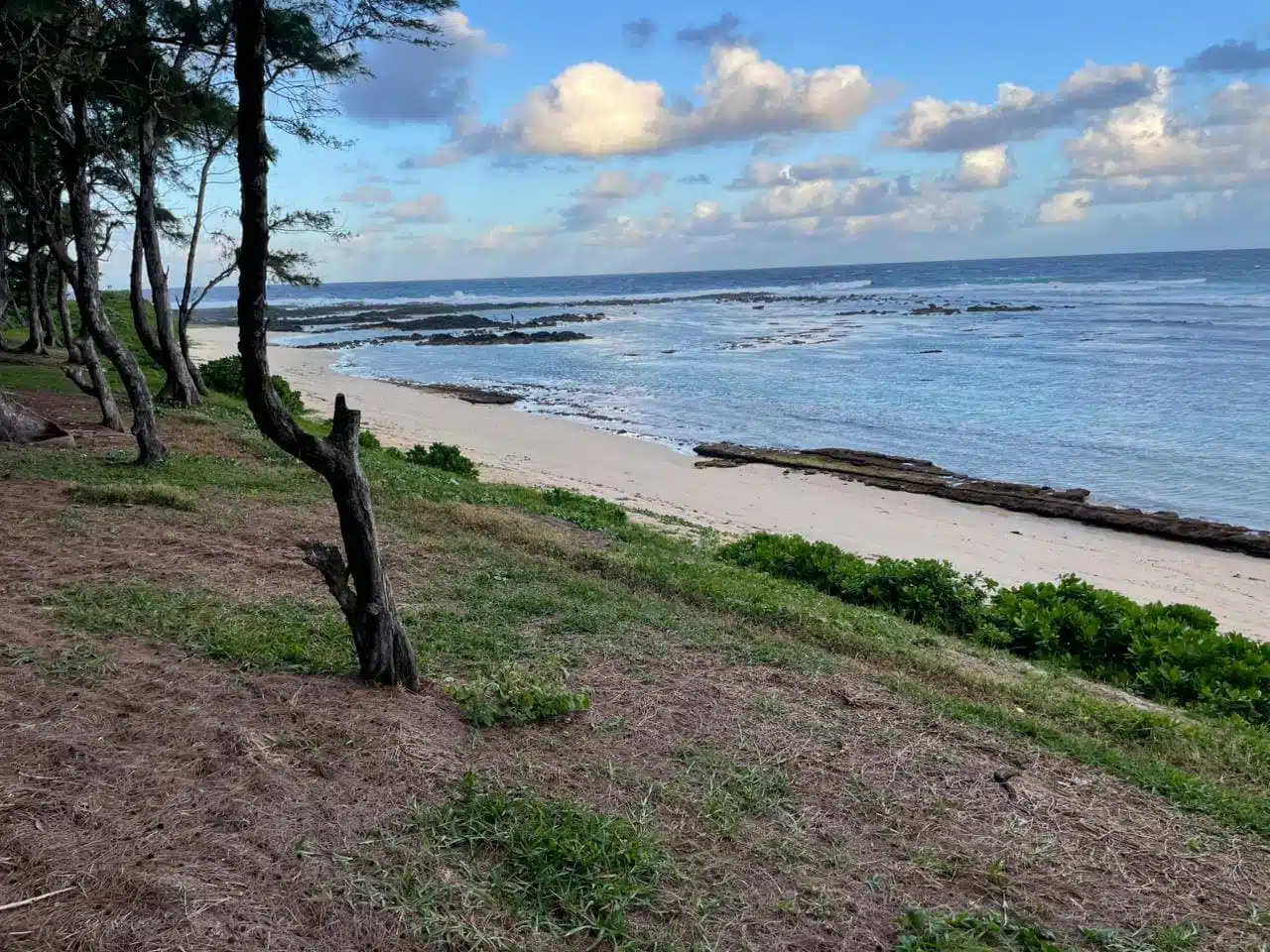
Its first job is protection. The dune is a buffer between the ocean and the land behind it. When a storm pushes high water and heavy surf onto the shore, the dune absorbs that energy and takes the brunt of the damage so the land behind it does not. Its second job is supply. A healthy dune is a reservoir of sand: rough seas pull sand off the beach, calmer months return it, and the dune holds the reserve that keeps the beach from disappearing over time. Its third job is shelter — it blocks salt spray and wind from the plants, soil, and any freshwater behind it.
All of this is slow and easily undone. A dune can take years to build and a single severe season to lose, and once the binding plants are stripped — most often by foot traffic cutting across them — the sand goes with them and does not readily come back.
That is why there is a marked path, and why you keep to it. Not as a rule imposed on the visitor, but because the dune is doing work that predates your arrival and will outlast it, and crossing the vegetation is the one thing that undoes that work. Staying on the path is a small decision, made with your feet, and it is most of what conscious travel actually means once you strip away the language around it.
The colour is not one colour. Over clear sand, it holds that vivid turquoise; where the floor drops away, it deepens to blue, almost ink in the deepest patches, and the coral shows as darker mottling you can map as you go.
Reading the ocean
Out to your left, the whole walk, the ocean keeps changing.
The colour is not one colour. Over clear sand, it holds that vivid turquoise; where the floor drops away, it deepens to blue, almost ink in the deepest patches, and the coral shows as darker mottling you can map as you go. The break shows as a hard white line further out, where the swell finds the shallow reef, and the foam of it drags back in long pale threads before the next set arrives. The water is clear enough that the colour of the floor shows through, not the surface, which is why it shifts metre by metre as the bottom shifts.
None of this performs for a camera, exactly. A still photograph flattens it into a blue rectangle and loses the part that matters: that it is moving, that the colour is information about depth and floor and current, that the coast rewards the person who stands and reads it over the person who frames it and moves on. It is built for the long look rather than the quick one.
The royal palms
The walk has a turn in it, and the turn is the point.
After a kilometre and a half of exposure — open water, wind that doesn’t let up, the glare off the sand — the path reaches a stand of royal palms, and everything drops a register at once. The trunks rise straight and grey and evenly spaced, smooth as columns, and the canopy closes high overhead so the light comes down filtered and vertical, the way light comes into a tall room. The constant wind falls to a movement in the crowns far above your head. And the sound of the sea — the thing that has defined the whole walk — pulls back to a murmur behind you.
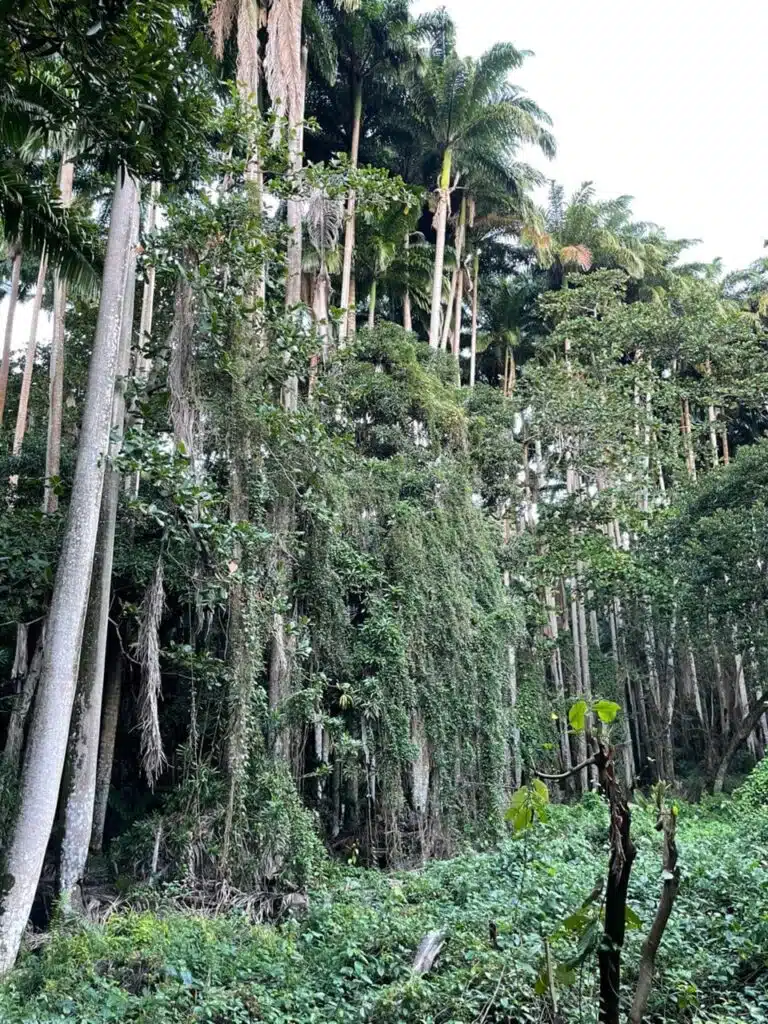
The contrast is the experience. The exposure is what makes the calm legible; you would not feel the groove the same way without the kilometre and a half of open coast that earns it. This is a coastline that works in two movements — the ocean and then the shelter from it — and the royal palms are where the second movement lands. You arrive at stillness rather than being delivered to it.
It is worth saying that this calm is not programmed. No schedule produces it, no treatment that books it. It is what the place does to you if you walk far enough into it and then stop.
Two days exploring the south coast of Mauritius
We spent two days exploring the south coast with Constance Le Chaland as our base — a comfortable launch point a short distance from La Cambuse, well placed for getting onto the coast early and getting back off it slowly.
The south coast is a layer. It rewards the traveller who treats Mauritius as a place to read rather than a list to complete — who is content to walk a kilometre and a half, sit in a palm grove, and let a rough, clear sea do the rest. It is the part of the island that asks something of you and gives accordingly.


Practical notes
Where is La Cambuse beach?
La Cambuse is a public beach on the south-east coast of Mauritius, near Mahébourg and a short distance from Plaisance. It marks the start of an open, largely undeveloped stretch of coastline that runs south.
Is the south coast of Mauritius good for swimming?
The south coast is more exposed than the island’s lagoon-protected beaches, with clearer but rougher water and stronger currents in places. It is best appreciated by strong, confident swimmers who read conditions carefully, and by walkers; less suited to small children or those wanting flat, sheltered water, who are better served by the island’s lagoon beaches.
What is the difference between the south coast and the lagoon coast?
Much of Mauritius is ringed by a coral reef that holds a band of calm, shallow, pale water — the lagoon — between the reef and the shore. Along the south coast the reef sits closer to land or opens up, so the open ocean reaches the beach more directly. The water is clear but more active, the colours run from pale celeste to deep turquoise, and the coastline is wilder and less developed.
Why stay on the marked paths through the dunes?
Coastal dunes are built by wind-blown sand and held together by the plants growing on them, whose roots bind the sand into a stable form. They buffer the coast against storm waves, store the sand reserve that keeps beaches from eroding, and shelter the land behind them from salt and wind. They take years to form and are quickly lost if the binding vegetation is damaged — usually by foot traffic — so keeping to marked paths protects the structure that protects the coast.
How much time do you need on the south coast?
A couple of days is enough to walk the coastline unhurried, spend time in the water, and rest — which is the way the south coast is best taken. It suits a short, deliberate stay rather than a packed itinerary.
Call or Whatsapp us for inquiries about our journeys.
Email us your travel inquiry.
Vivea Business Park, Moka. Mauritius Island.